
Present continuous en ingles – progressive tense Uso y estructura – Leccion 8 gratis con audio
CURSO GRATUITO DE INGLES CON AUDIO Lección 8 – GRAMATICA Grammar (Present continuous en ingles) Hacer click en play para escuchar el audio. Bajar la clase a tu pc haciendo click derecho sobre “download” y guardar vinculo como.

Podcast: Download
Subscribe: Apple Podcasts | Spotify | TuneIn | RSS
In this lesson we will cover the present continuous tense (the use and structure). Recuerden de votar por InglesTotal AQUI (bajo EDUCACION)
The Present Continuous or present progressive tense
- Structure: S + verb to be (AM/IS/ARE) + –ing form of a verb+ Complement.
- Use: To describe actions that are happening at the moment (NOW).
La estructura consta del uso del verbo mas el gerundio. se usa para describir acciones que suceden en el momento. Se usa para explicar lo que uno esta haciendo ahora.
I) The positive form of the present continuous.
– Remember to use the Subject (this can be a subject pronoun or a noun –LESSON 1 Click AQUI) plus (+) the verb to be in the present tense (am/is/are) and complement (optional).
The following is the table of the positive form of the present continuous / progressive.
Table #1 :Positive Form
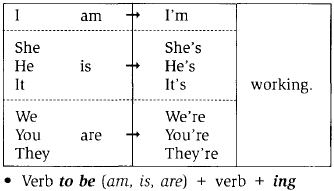
Common mistakes:
– Students forget to use the verb to be
Example:
a) My father working (INCORRECT) —> My father IS working. (Correct)
– Sometimes students do not use the -ing form.
b) Robert is play with my sister (INCORRECT) —> Robert is playING with my sister. (CORRECT)
Recuerden de no omitir el sujeto. En español “Esta comiendo” esta usando un sujeto tácito. En ingles siempre debemos decir quien hace la acción (salvo en el imperativo) Entonces en “esta comiendo” el sujeto puede ser el, ella, o ello. En ingles seria “He/she /it is eating” dependiendo del contexto.
II) The negative form of the present continuous
The negative form is used by adding “not” after the verb to be in the present tense form. You may use contractions.
Table # 2:The negative form.

Common mistakes:
-Some students place the negative first. REMEMBER TO USE THE S+V+C !!!
a) Not working my father (INCORRECT) —> My father isn’t (is + not) working (CORRECT)
– Students use the don’t/doesn’t to do the negative:
b) She doesn’t playing (INCORRECT) —> She isn’t playing (CORRECT)
III) The question form of the present continuous.
We have to put the verb to be + the subject + –ing form + the complement.
Are you watching TV?
Remember that we can use the Question words before the structure:
Examples:
– What are you doing? Answer: I am studying English with my virtual teacher.
– Where is Pedro going? Answer: He is going to the shopping mall.
Table # 3: Question form


Common mistakes:
– Students do not change the order of the verb to be with the subject:
a) He is working? (INCORRECT) —> Is he working? (CORRECT)
– Students use do or does in questions:
b) Do you studying? (INCORRECT) —> Are you studying? (CORRECT)
IV) Let’s practice ! (Ejercicios de practica)
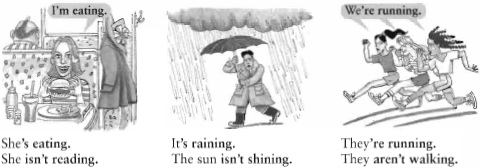

V) Exercises (ejercicos) – TAREA – HOMEWORK:


* FIGURAS Y EJERCICIOS DE GRAMMAR IN USE (Cambridge) Grammar practice (LONGMAN)


Hasta ahora estoy empezando con las clases, gracias por las clases, desde Honduras
El mejor profesor!!! ❤️
muy buena leccion
Buenos dias profesor.
porque ya no cuelga los ejercicios con las soluciones abajo,es mejor de esa manera para poder corregirnos.
Gracias por su apoyo.
las respuestas en los audios.
Excelente pagina profe saludos desde Colombia, ¿para cuando el curso mas avanzado?
Gracias profesor, muy buena su clase y entretenida.
Mil gracias Teacher Carlos!!! gracias a ti entiendo mil cosas soy mega fan de tu pagina, estoy en nivel básico y me parecen geniales tus clases soy de México y te mando muchas bendiciones y que siga tu exito nunca dejes de enseñar. Tambien soy maestra de Preescolar y bueno nunca es tarde pero tu me lo haces mas facil gracias de corazon
Hola buen dia
tengo una pregunta
No he podido escuchar algunos audios por que al momento de darle play me sale que el archivo no existe, cual es la razon para que ocurra esto, si es problema de la pagina o del explorador.
Por favor me ayudan que me parecen muy interesantes todas las clases
gracias
seguro es su navegador. Revisé yo mismo los audios y funcionan bién.
Hola profesor Carlos, estoy muy agradecido por su forma de explicar el inglés, ya he estado compartiendo su página con mis amistades y compañeros de estudio. En mi caso estoy escuchando las primeras lecciones de básico aunque me gustaría escuchar las lecciones en línea pero ahí escucharé sus comentarios en las siguientes lecciones, un saludo desde Costa Rica
Hello!, Carlos, Thanks for this lessons!, i´m 10 years old and i can understand your lessons =)
Hola!, Carlos, Gracias por estas lecciones, tengo 10 años y puedo entender tus lecciones =)
Lucho XD
EXCELENTE METODO DE ENSENANZA. ESTOY FELIZ Y AVANZANDO EN MI APRENDIZAJE DEL IDIOMA INGLES. AGRADEZCO SU INTERES EN AQUELLAS PERSONAS QUE LO DESCONOCEMOS. QUE DIOS LO SIGA BENDICIENDO POR TAN HERMOSA Y LOABLE LABOR .