
Como decir “Espero” en inglés correctamente
SECCION: Conversation / Speaking Activity – Clases de conversación #55 – Como decir “ESPERO” en inglés

Podcast: Download
Subscribe: Apple Podcasts | Spotify | TuneIn | RSS
Hoy tenemos una nueva publicación en nuestra sección y curso de Speaking o conversación en inglés. Hoy voy a compartir 4 verbos en inglés para decir ESPERO. UNASE a nuestra comunidad en WHATSAPP y mande sus preguntas. Siga este enlace https://chat.whatsapp.com/I81V7uakMSk2bCmdD2qibE?mode=ems_copy_t .Tambien siga la clase con el audio que incluye una conversación al final para solventar lo aprendido. Esto le permitirá ser un poco mas natural cuando se expresa en inglés Para poder ver todas nuestras lecciones hasta la fecha en esta sección pueden ir a ESTE VINCULO.
Esta clase escrita viene acompañada de un audio que pueden encontrar al comienzo de esta publicación. Tampoco olviden de seguir redes sociales en Facebook y Twitter para más información de nuestros cursos gratis y sigan. Nuestros audios están en SPOTIFY (enlace aquí) y los que quieran compararme un café o donar para que esta pagina siga adelante pueden hacerlo usando este vinculo.
Introducción
Si hablas español, seguramente usas la palabra “espero” para todo: para decir que estás en la parada del autobús, para desearle suerte a un amigo o para contar que estás emocionado por tus vacaciones. En nuestra mente, todo es esperar.
Sin embargo, cuando intentamos pasar ese “espero” al inglés, nos topamos con un muro. Lo que en español es una sola idea, en inglés se divide en cuatro palabras completamente distintas.
¿Alguna vez has dicho “I wait you tomorrow” (ERROR) queriendo decir que tienes ganas de ver a alguien? Podrías estar diciendo algo muy diferente a lo que imaginas. En este post, vamos a desglosar estas cuatro diferencias de forma sencilla para que dejes de traducir palabra por palabra y empieces a sonar como un nativo
How to Say “Espero” in English: Why One Spanish Word Becomes Four Different Ideas
For many Spanish speakers, one of the most confusing words to translate into English is: “espero.” That is because in Spanish, the verb esperar can express several different ideas:
- wanting something to happen
- waiting for someone
- feeling excited about the future
- believing something will happen
In English, however, these meanings are separated into different words. The most common ones are:
- hope
- wait
- look forward to
- expect
Although they may all seem similar at first, each one expresses a very different idea.
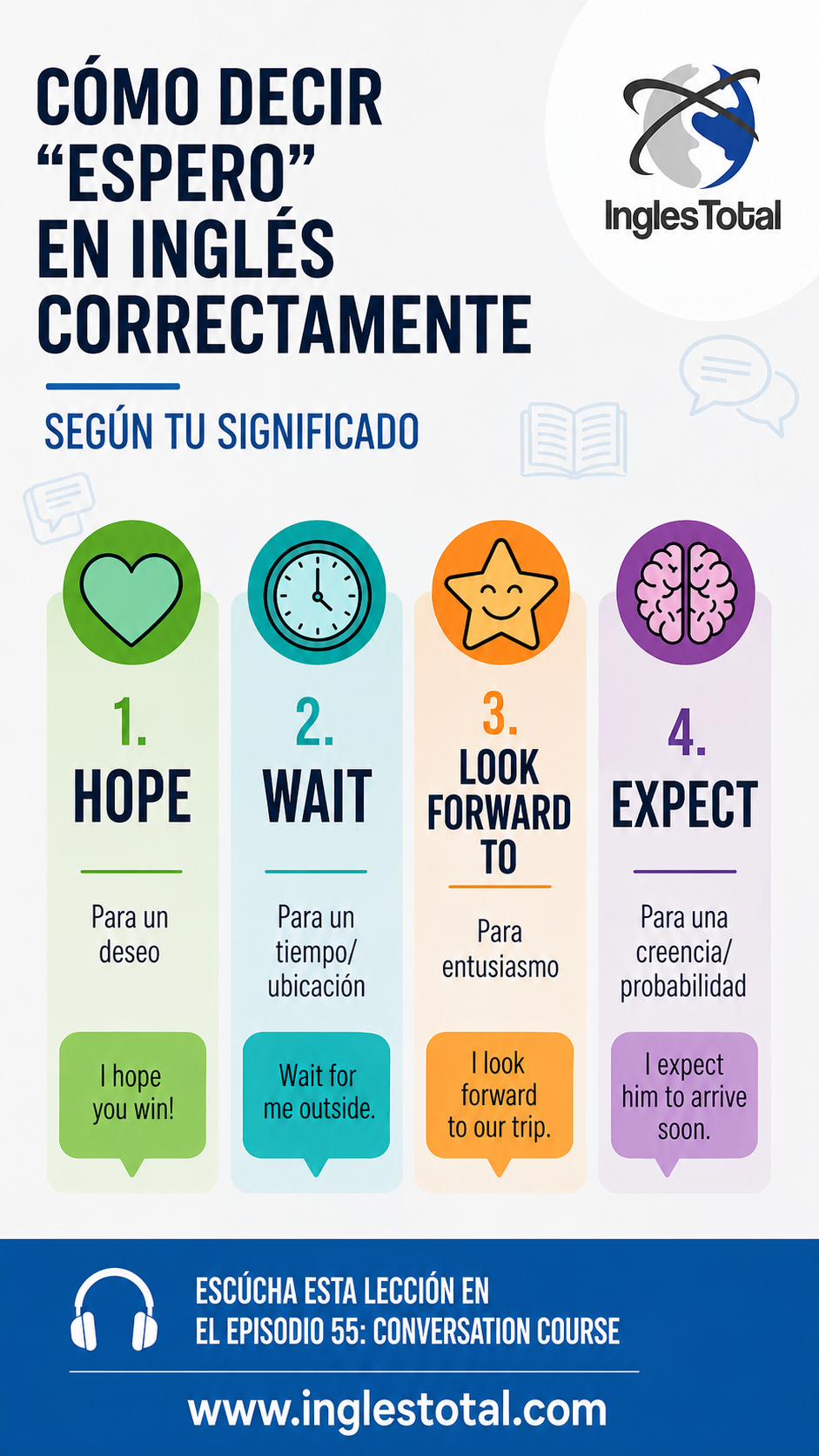
1. HOPE → when you want something to happen. Use hope when you are talking about a desire for the future. You are not simply describing the future.You are expressing a personal wish.
Examples
Espero que te vaya bien.
→ I hope everything goes well.
Espero verte pronto.
→ I hope to see you soon.
Espero que consigas el trabajo.
→ I hope you get the job.
Meaning
When you say hope, you are saying: “I want this to happen.” It often carries emotion.
I hope she calls.
= I want her to call.
2. WAIT → when you remain until something happens. Use wait when you mean staying somewhere until someone or something arrives. This meaning is physical or practical.
Examples
Te espero aquí.
→ I’ll wait for you here.
Estoy esperando el autobús.
→ I’m waiting for the bus.
Espera un momento.
→ Wait a moment.
Meaning
When you say wait, you mean: “I stay here until something happens.”
I’m waiting for the doctor. = The doctor has not arrived yet.
3. LOOK FORWARD TO → when you feel happy about the future . Use look forward to when something in the future makes you feel positive or excited. It is stronger than hope because it includes enthusiasm.
Examples
Espero con ganas verte.
→ I look forward to seeing you.
Espero tus noticias.
→ I look forward to hearing from you.
Espero las vacaciones.
→ I’m looking forward to the vacation.
Meaning
It means:
“I feel happy about this future event.”
Important grammar
After look forward to, use:
verb + ing
Correct:
✅ I look forward to meeting you.
Not:
❌ I look forward to meet you.
4. EXPECT → when you believe something will happen. Use expect when you think something is likely.It expresses belief, not emotion.
Examples
Espero una llamada esta tarde.
→ I expect a call this afternoon.
Espero que lleguen pronto.
→ I expect them to arrive soon.
Esperamos mejores resultados.
→ We expect better results.
Meaning
When you say expect, you mean:“I think this will probably happen.”
I hope she comes.
= I want her to come.
I expect she’ll come.
= I believe she will come.
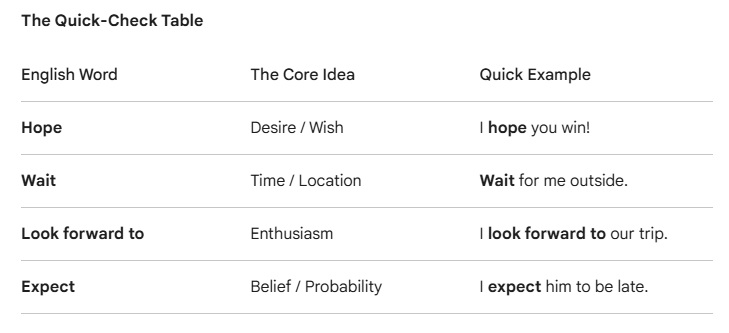
One Sentence, Four Meanings
Look at how the meaning of “Te espero” changes depending on your choice:
-
“I hope to see you.” (I really want us to meet up.)
-
“I’ll wait for you.” (I am standing on the corner waiting for you to arrive.)
-
“I look forward to seeing you.” (I’m so happy we have plans!)
-
“I expect you.” (I believe you will arrive because we have an appointment.)
Final Tip for Learners
The next time you want to say “espero,” take a half-second to pause. Ask yourself: Is this a desire, a clock, a smile, or a prediction? Once you know the category, you’ll never choose the wrong word again!
Básico | Pre intermedio | Intermedio (nuevo) |Clases de Conversación | Lectura | Pronunciación |Material y Recursos | Vocabulary


Leave a Reply