
Simple present positive form – La forma positiva de el presente simple en ingles (LECCION 10a-grammar)
Curso de INGLES Gratis con audio – LECCION 10a (LESSON 10a) GRAMATICA – GRAMMAR
Para escuchar la clase hacer click en el icono de play. Si desean bajarlo a su mp3 player hacer click derecho en download y guardar vinculo como.

Podcast: Download
Subscribe: Apple Podcasts | Spotify | TuneIn | RSS
Welcome to lesson 10a (1st of two parts) where we will talk about the present simple tense with other verbs that are not the verb to be. We are going to look at the structure and the use of the simple present tense.The present simple tense (with verbs that are not TO BE)
-
Structure / form:
The forms (or conjugations) of the present simple tense are two. Remember that with the verb to be there are three forms (am, is, are). To form the present simple conjugations we first need to have the verb. In this example we will use the verb to play.
Verb to play
One conjugation is formed by eliminating the “to” — > play
The other conjugation is formed by adding “s” or “es”. —>plays
So you can now form the conjugations of any verb in the present simple!
– to work: work / works
– to study: study / studies
– to watch : watch / watches
– to bring : bring / brings
– to get : get / gets
– to dance: dance / dances
Note : With the verb to have the conjugations are —> have / has (NOT haves)
Now we learned to conjugate and form the verbs. Let’s learn what pronouns go with the correct form.
He / she / it ————> with the “s” form (plays)
I / you / we / you / they ———-> normal form without the “to” (play)
*Como vemos, en el present simple existen solo dos conjugaciones con los verbos que no son “to be” (con los to be son tres conjugaciones : am, is, are). Estas dos conjugaciones son formadas muy fácilmente. Una es formada con solo quitarl
e el “to” (play) y la otra forma es agregándole la letra “s” o “es”. Cuando comparamos con el español vemos que esto es mas sencillo puesto que con el verbo jugar las conjugaciones son: juego, ju
egas, juega, jugamos, jugáis, y juegan. Entonces si hablan el español el ingles véanlo como algo mas simple y sencillo.
Figure #1: The positive form of the simple present tense

-
Use (uso del presente simple)
Now that we know the structure/form it is IMPORTANT to understand when we use the simple present. This will help us talk and participate in conversations. Without knowing the use, we will have problems expressing ourselves.
We use present simple in the following situations:
– To express habits and routines.
Juan plays football on Saturday.
I go to work everyday at 8:00 am.
– General, mathematical and scientific truths:
English people drink a lot of tea
Water boils at 100 degrees Celsius.
NOTE: THE SIMPLE PRESENT TENSE IS NOT USED TO DESCRIBE SITUATIONS THAT ARE HAPPENNING AT THE MOMENT (NOW)
**La forma y estructura es importante pero es indispensable saber el uso. Es decir, tenemos que entender cuando y en que situaciones utilizamos el simple present tense. Estas es la única forma de empezar a pensar en ingles. Cuantas veces me encuentro con alumnos que saben rellenar un examen pero no saben hablar. Esto es porque no prestan atención al uso. El uso les permitirá usar el tiempo correcto en la situación correcta y les ayudara a tener conversaciones fluidas. Olvídense de traducciones antes de hablar ingles. Esto les traerá problemas y les hará hablar lento. Simplemente piensen y practiquen el uso de los tiempos.
Como vemos usamos el tiempo present simple cuando queremos expresar, rutinas, hábitos, y verdades generales, matemáticas científicas. NO SE UTILIZA EL PRESENT SIMPLE PARA EXPRESAR UNA ACCION QUE ESTA SUCEDIENDO EN EL MOMENTO:
Figure #1: The positive form of the simple present tense
Common errors:
Remember that when we use “other verbs” we DO NOT use the verb to be:
– I’m have two sisters (INCORRECT) — I have two sisters (Correct)
– She is plays in the park (INCORRECT) —– She plays in the park (Correct)
*Recuerden de no usar el verbo to be cuando quieran expresar otra acción. “I” va con “am” solo cuando ustedes quieran decir estoy o soy. SI quieren decir: Yo juego, no es posible decir “I am play” puesto que están diciendo que yo soy/estoy jugar.
Figure # 2: Let’s practice
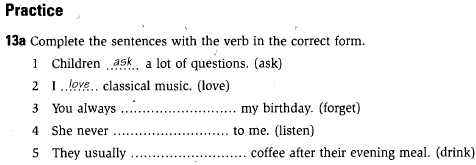

Figure # 3 (Look at the pictures and practice)

HOMEWORK
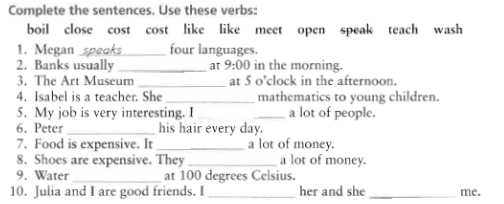
* FIGURAS Y EJERCICIOS DE GRAMMAR IN USE (Cambridge) Grammar practice (LONGMAN)


hola estoy iniciando con tus magnificas lecciones muchas gracias por este aporte, solo una pequeña duda cuando escribes los pronombres se sobreentiende que you es sea tu que vosotros verdad ya que n lo veo escrito en los ejemplos, muchas gracias